You Can't Win Anything With Kids": The Business Case for Trusting What You Can't Measure
By Padraig O'Donnell
16 August 2026 · 7 min read
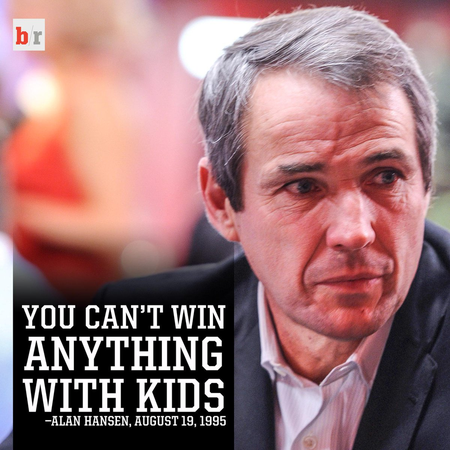
Alan Hansen's famous line, delivered in August 1995, has aged badly.
Hansen, the legendary Liverpool player turned pundit, directed it at Manchester United after Alex Ferguson decided to trust a group of young players. Unfortunately for Hansen, United went on to win the Premier League and FA Cup that season.
The quote has since gone down in the annals of the game. It's a line Hansen can probably never shake off.
But beyond the humour, it captures something interesting about decision-making.
How do you know when you're looking at potential rather than simply inexperience?
It's that time of the year again. Transfer deadline day is looming, pundits are making their predictions and pre-season Pelés are waiting to be found before fading the moment the real thing gets going. It's also time for my fantasy football selection. My chance to be the gaffer, without any of the real-life jeopardy.
I start every season the same way. How can I get Bruno Fernandes and Erling Haaland into my team? Then the doubt creeps in. Can Bruno really be as productive as last year? Will Manchester City decline a bit under Maresca? Maybe I'm better off taking a punt on Alexander Isak.
So I start looking for hidden value. Players coming up from the Championship. Young players and older players I've barely heard of and searching for someone who might suddenly explode onto the Premier League scence this seasom.
And that's when I run into the same problem every season.
There's no metric for "might be brilliant."
Two managers, two bets
It's the same question, at a much higher level, that two of the best managers European football has produced faced with far greater stakes.
Alex Ferguson at Manchester United in the 1990s and Carlo Ancelotti at AC Milan in the 2000s built two of the greatest teams of their eras, but they answered the question in completely different ways.
I grew up a Manchester United fan, so I lived through Ferguson's side of the story. I watched those academy graduates come into the first team and half expected it to go wrong. I knew Milan's great sides well too, but I only really came to appreciate Ancelotti's approach after reading his autobiography and then writing about him in my article on Brazil losing their way.
The difference was simple: Ancelotti bought proven performance. Ferguson backed potential.
Both were right.
A game with no combine
American professional sport has built an entire system around reducing this uncertainty. A highly competitive college system produces years of performance data before a professional team drafts a player. The combine adds more: speed, strength, movement and decision-making under pressure. Scouts, interviews and medicals add another layer.
It doesn't remove uncertainty. But someone has already done a lot of the work of measuring it.
Football doesn't really have an equivalent. An academy player might perform brilliantly in the Under-21s, but there is no competitive development system that tells you with any real certainty how that player will perform against Premier League opposition.
That leaves managers with a difficult choice: pay for what you know, or back what you believe.
Buying certainty
Ancelotti's Milan largely chose certainty.
Under Ancelotti, Milan won the Champions League in 2003 and again in 2007, with a Serie A title in between. The 2003 side was built around proven players such as Nesta, Rivaldo and Seedorf. By 2007, the starting eleven that beat Liverpool had an average age of 31.
Ancelotti wasn't simply buying expensive players. He was buying evidence. Players who had already performed at the highest level, under pressure, in different environments.
But that creates another challenge. Proven players bring proven performance, but they also bring egos, expectations and histories. The manager still has to make those personalities work together.
Anyone can buy talent. Building a team from it is different.
Ancelotti was very good at that.
Betting on potential
Ferguson made almost the opposite decision.
United went into the summer of 1995 having lost the league by a single point to Blackburn Rovers. His response wasn't to bring in experienced replacements. He sold Mark Hughes, Paul Ince and Andrei Kanchelskis and trusted the young players already inside the club.
Giggs had already broken through. Beckham, Butt and Neville followed. Scholes was emerging. Ferguson knew these players better than anyone outside the club because he had watched them develop for years.
That's what makes the Hansen quote so interesting.
Ferguson wasn't simply gambling on kids. He had information that wasn't available to everyone else. He knew their personalities. He knew how they responded to pressure. He knew their strengths and weaknesses. He had watched them develop long before they became Premier League players.
The data wasn't missing. It was in Ferguson's experience.
And the proof came a few years later.
By the time United completed the Treble in 1998/99, roughly one in three players in Ferguson's squad had come through the club's academy. Eight of the 25-man Champions League Final squad were academy graduates, including Giggs, Beckham, Scholes, Butt and the Neville brothers, along with Wes Brown and Jonathan Greening. Four of them started the final against Bayern Munich. Paul Scholes, another academy graduate, was suspended, while Phil Neville, Wes Brown and Jonathan Greening were all on the bench.
This wasn't Ferguson getting lucky with one or two talented youngsters. He had backed an entire generation. In 1995, the question was whether these kids were good enough. Four years later, they were the backbone of the team that had won the Premier League, FA Cup and European Cup.
There is difference between gambling on potential and recognising it.
Judgement
This is where the work of psychologist Gary Klein becomes interesting.
Klein spent years studying how experienced people make high-stakes decisions when they don't have time, or enough information, to analyse every option. Firefighters, military commanders and medical professionals often have to make decisions before the data gives them a complete answer.
His research found that experienced decision-makers often recognise patterns from previous situations and act on them quickly. It isn't simply intuition. It's experience compressed into judgement.
That's what Ferguson did.
He had spent years watching those players develop. He had seen how they behaved, how they responded to setbacks and how they handled pressure. He had information that couldn't easily be captured in a scouting report or spreadsheet.
It wasn't a guess. It was judgement built from experience.
The trade-off in business
The same decision plays out in business every day.
Do you hire an experienced executive from outside who can perform immediately, or promote someone who has grown up inside the organisation? Do you buy proven technology or back something new? Do you enter a market where there is already evidence of demand, or invest in something you believe could become the next big opportunity?
Proven talent gives you evidence and reduces uncertainty. But it doesn't guarantee fit.
Internal talent gives you context. They understand the culture, the people and how the organisation actually works. But developing potential takes time and there is no guarantee the person will make it.
There is no universal right answer. It depends on the situation, the resources available and how much uncertainty the organisation can afford to take.
The skill in buying well
That's why I don't think this is really a story about data versus judgement.
Ancelotti used evidence. Ferguson used experience. Both still needed judgement.
Ancelotti had to know which proven players would fit together, which personalities would work and which players could adapt to his system. Ferguson had to know which young players were ready to step into an environment where failure was very public.
Different inputs. Same decision.
Back to fantasy football
Which brings me back to my own fantasy football selection. I can look at last season's goals, assists, minutes, expected goals, fixtures, everything the fantasy websites can give me. I can read experts' reviews, study the run of games, convince myself I've found the hidden gem nobody else has spotted.
But, as Klein argues, potential is different. I still don't have a metric for it. I'm not sure I ever will.
And that's the point.
Data can tell you what someone has done. Experience can tell you what someone might do next.
The best leaders understand the difference, and know that sometimes the decision has to come down to their judgement.
Blog by Padraig O'Donnell